Last Updated : 05/07/2026
- Part I: Voter Integrity
- Part II: Voter Rolls Integrity
- Part III: Voting Software Integrity
- Part IV: Voting Hardware Integrity
- Part V: Election Day Voting Integrity
- Part VI: Election Day Tabulation Integrity
Part I: Voter Integrity
Section 1 of Amendment 15 to the U.S. Constitution provides “The right of citizens of the United States to vote shall not be denied or abridged by the United States or by any State on account of race, color, or previous condition of servitude”.
Voting in all elections is a fundamental right, obligation, and responsibility of each and every citizen. And there is no better way to secure democracy than to ensure that everyone has not only the right to vote, but also the meaningful opportunity to cast their ballots.
I see only three requirements for a person to become eligible to vote:
- A person must be a citizen of the United States,
- Must be of majority age, and
- Must not be a convicted felon unless:
- They are no longer under the supervision of the government for any probation or post incarceration probation and have paid in full any fines or penalties,
- Have applied for restoration of their voting right, and
- The restoration has been approved.
Once a person becomes eligible to vote, I believe there should be three requirements:
- Once a citizen reaches majority age (currently 18 years old), they should be
required to register to vote, and
Thought – I believe it is a duty and obligation for every American citizen to exercise their right to vote and have a say in how they are to be governed. We already require 18 year old males to register for the Selective Service so it shouldn’t be much of a stretch to expand the requirement to females for voting purposes and do both at the same time.
- Required to obtain a FREE Enhanced Voter ID or an Enhanced Real ID
Driver’s License, or Enhanced Real ID for identification purposes only.
Thought – These ID cards would instill truth, faith, and renewed confidence in the election process that only American citizens eligible to vote are casting a ballot. All IDs would indicate the applicant is a citizen of the United States. The REAL ID Act of 2005 would need to be updated in order to fulfill the ID requirements.
To make a standard REAL ID legally accepted as proof of U.S. citizenship, federal law (the REAL ID Act of 2005) would need to be amended to remove legal presence eligibility for non-citizens or, more practically, to require universal adoption of "Enhanced Driver's Licenses" (EDLs) that explicitly verify and mark citizenship.
An Enhanced Driver’s License (EDL)—distinct from a standard REAL ID—requires proof of U.S. citizenship, identity, Social Security number, and state residency, usually with original or certified documents. Key documents include a valid U.S. passport or birth certificate, SSN card, and two proofs of residency.
- Finally, the citizen would be required by law to keep their voter information correct and up-to-date.
Thought – No less than one month prior to any election period for it to become effective for that election. Updates made after that time frame would not take effect until after the current election period. This allows ample time for the election system to be updated properly.
Where can a citizen obtain a FREE Enhanced Voter ID card?
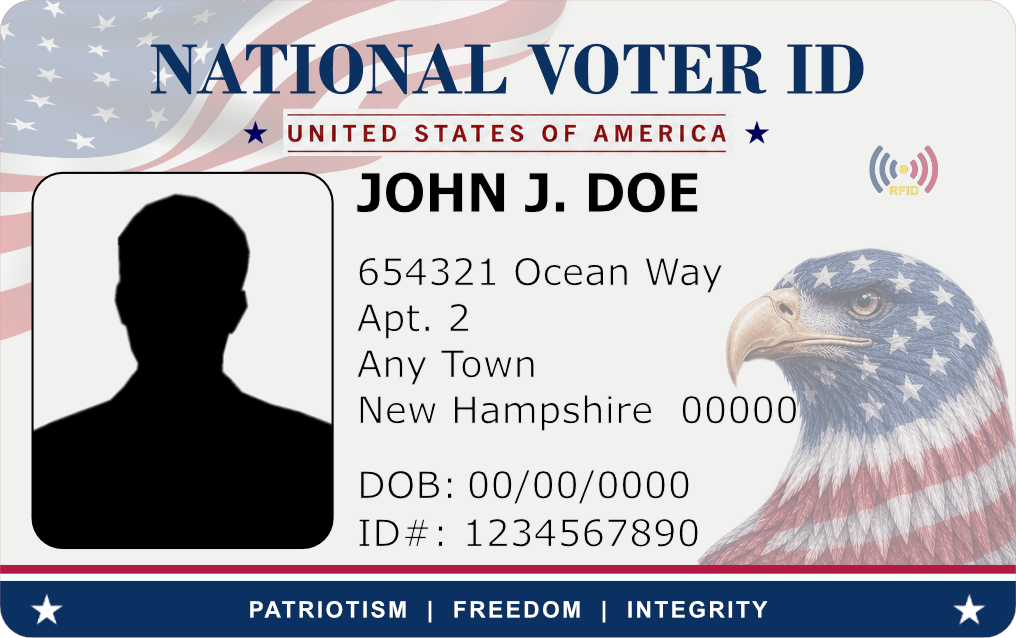
What information should be on the Voter ID card?
I believe the following information is the bare minimum to correctly identify any individual who wishes to vote. The ID is presented to the poll worker to identify the voter, so the ID needs to clearly identify the voter and the poll worker needs to be assured it is legitimate.
-
Thought – The question then becomes what if the voter loses the FREE Enhanced Voter ID and wants to present a different REAL ID in order to vote? What procedures are to be in place if this is allowed? What checks and balances to ensure the voter is who they say they are?
-
Thought – How are absentee ballots handled with voter ID? What steps are taken to verify the identity presented for the absentee ballot?
- ID no. - A unique 10 digit document identifier - 1234567890
- Name - First name, Middle Initial, Last Name, Suffix - John J. Doe
- Address - Street Address (PO Box numbers are not valid. Must be a physical address) - 654321 Ocean Way
- Address2 - Additional address line for Apartment, Suite, Room number - Apt. 2
- City - Any Town
- State - New Hampshire
- Zip Code - 00000
- Date of Birth - 2 digit month, 2 digit day, 4 digit year - 00/00/0000
- Photo
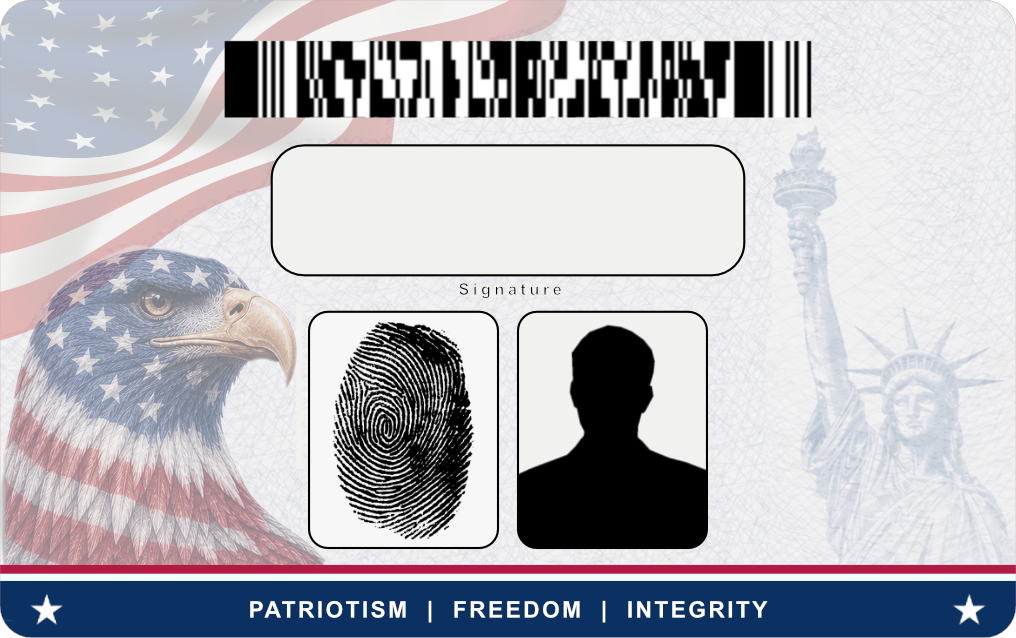
- Thumb Print - This is a digital thumb print
Thought – The voter could also initiate a thumb print in the scanner as an additional verification of identity. The thumb print is then compared to the thumb print on the ID by the poll pad/scanner. If the identity is confirmed then the voter card can be created.
- Signature
Security Features:
- Watermark
- American Flag – micro printed
- Barcode
- Hologram photo
- A Near-Field Communication (NFC) RFID, ideal for secure, short-range interaction
- The RFID could store a photo and thumb print of the individual as well as a digital authenticated copies of the documents presented to obtain the ID
Thought – The smart chip could have an encrypted key that when the ID is presented to identify the voter, the key in each would be read by the poll pad and have to match. This would reassure the poll worker that the ID is legitimate.
Part II: Voter Rolls Integrity
These are some items I am working on:
- Broaden the mission of the Federal Election Commission (FEC) to not only protect the integrity of the federal campaign finance but to protect the integrity of the voter rolls.
- FEC to maintain the voter roll. Download citizen information from SSA birth records and death records and any new SSN issued and when a citizen turns 18 they are added to the eligible voter roll. It is then the responsibility for each citizen to register to vote.
- Updates to the voter rolls from state DMV offices and the state secretary of state offices in issuing new ids for changes of address and any other relevant information and then verified by the citizen.
- Must have citizenship designation and declaration on any eligible voter ID.
- Citizens can update their voter information online with verifying documentation uploaded.
- The FEC voter roll is shared with the relevant state electoral commissions to ensure their voter information is correct.
- Protect election records, election infrastructure, and ballot tabulation by strengthening protections for Federal election records and election infrastructure in order to protect the integrity and security of ballots and voting systems.
- Any tampering with the database must have harsh penalties.
- Anyone convicted of falsely manipulating the database itself, faces a minimum fine of $100,000 and a 10 year prison term.
- Anyone convicted of falsely providing voter information (either of themselves or others), face a minimum fine of $25,000 and 2 years in prison for each voter that misinformation was given.
Thought –
Part III: Voting Software Integrity
I am not a software engineer so I could really use some help on this part.
Registration Software:
Part IV: Voting Hardware Integrity
I am also not a hardware engineer so I could really use some help on this part too.
- Registration hardware
- Poll Pad
- Ballot Marking Device
- Printer
- Scanner
- County tallying device to upload results to State
- State hardware to receive and tabulate election totals
Thought –
Part V: Election Day Voting Integrity
Thought – Common barriers cited by voters not casting their ballots in-person or returning absentee ballots are getting time away from their jobs, being too busy, and conflicting schedules. There is no federal law that requires voters be provided time off to cast their ballot, so that policy choice is left up to the states. Policymakers have taken two approaches to solve this issue: making Election Day a public holiday or requiring employers to provide paid time off for voting. If you look at the data, it shows that neither of these approaches solves the problem of getting a higher voter turnout. The States, on average, that have an election day holiday and require employers to pay employees for this holiday had a lower turnout in the 2024 presidential election (62.0%). In comparison, the States that did not have a holiday and didn’t require employees to be paid for time off to vote, had the highest voter turnout (67.6%).
Thought – So, what is the real reasons voters are not exercising their right to vote? Could it be voter apathy or lack of trust in the system or just plain not caring because they feel their vote doesn’t really count? Voting is a citizens’ civic duty, a right earned through struggle, and the foundation of a healthy democracy.
- Election cycle must be standardized so any citizen can expect the same no matter where in the country they go.
- Change Election Day to the first Saturday in November.
- Absentee ballots must be postmarked on or before the first Saturday in November.
- Requests for absentee ballots must be received by the appropriate election office no later than 5:00 PM, on the second Friday of October each year. This gives election officials ample time to process, cure any requests, and mail absentee ballots in time for the voter to receive it and return it by election day.
Thought – I believe we are making voting just as complicated as our tax system, so you need a lawyer and accountant to know the proper requirements. The same holds true for the actual voting day where you have the Election Day voting, absentee voting, and early voting. Some states with same day registration and some not. Some requiring ID and some not. Every facet of the voting process is different depending on your State.
- Implement a comprehensive voting system security evaluation and enhance election vendor cyber security standards, including standards for manufacturing and assembling all voting machines (tabulators, ballot marking devices, poll pads, etc.), among other key security measures.
- Design and implement a new computer system that allows a voter to cast their ballot anywhere in their home state and do away with the antiquated system of polling precincts. Further expansion of this system could include voting from anywhere within the United States for elections that fall on the even numbered years. (Federal elections)
- There will no longer be same day registration. New registration or change of registration must also be completed by 5:00 PM, on the second Friday of October of each year. This allows time for the voter roll to be updated and verified prior to early voting and election day.
- Early in-person voting begins at 8:00 AM local time on the 15th day prior to election day and continues for 10 consecutive days including weekends.
- All elementary schools become the only polling places on Election Day.
- Mandated third-party transparent, post-election audits.
Thought –
Part VI: Election Day Tabulation Integrity
These are some items I am working on:
-
Thought –